
The Architecture of Racial Hierarchy
Noughts & CrossesThis thread traces how an inherited racial order is enforced through daily customs, public institutions, and the language people use to define one another.
increasing Bearing strength in each event
 decreasing
Bearing strength in each eventdecreasingA Childhood Without Barriers

A Childhood Without Barriers
An Unequal Garden
Callum McGregor and Persephone Hadley play freely in the grounds of Hadley country house while their mothers watch. Their closeness suggests that the boundary between Noughts and Crosses is neither natural nor inevitable to the children.
The Adult World
Kamal Hadley’s arrival changes the atmosphere: a private quarrel and his assault on Jasmine Hadley expose the power governing the household. Meggie McGregor recognizes that her place depends on the Hadleys’ approval, even after years of service.
The scene establishes that privilege is embedded in homes, employment, and personal safety as well as in law. The children’s easy friendship exists inside a society whose adults already know which lives carry authority.
The Insult Made Ordinary
The Insult Made Ordinary
A Public Slogan
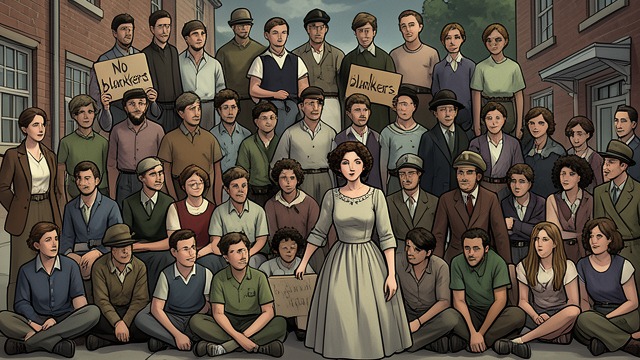
Cross pupils and adults gather outside Heathcroft High to oppose the admission of Nought students. The chant “No blankers in our school” turns a discriminatory policy into a public declaration that Nought students do not belong.
A Word with Consequences
Persephone Hadley tries to stop the crowd, but calls its members “blankers” as she does so. Callum McGregor hears the same dehumanizing word used against him and understands that her intention cannot erase its impact.
The confrontation shows how prejudice travels through language even when a speaker hopes to challenge prejudice. Callum’s demand that Persephone never use the word again marks the start of her recognition that words can reproduce the hierarchy they claim to oppose.
Segregation in the Lunch Hall
Segregation in the Lunch Hall
A Seat Across the Divide
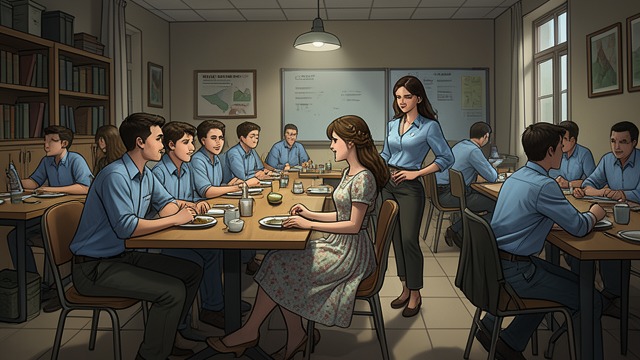
Persephone Hadley chooses to sit with Callum McGregor and the other Nought students, treating friendship as a reason to cross the school’s informal boundary. Her action is personal, but the room responds as if she has violated an established rule.
Authority Enforces the Custom
Deputy headmistress Mrs Bawden orders Persephone back to her “own” table and drags her away when she refuses. The episode reveals that segregation is protected not only by hostile pupils but also by adults empowered to discipline those who challenge it.
The lunch hall makes social hierarchy visible as spatial separation: who may sit together, who is watched, and who can invoke school authority. Persephone’s attempt at solidarity cannot undo the system, but it helps expose its rules as choices enforced by people rather than natural facts.
The History That Is Missing

The History That Is Missing
A Classroom’s Selective Past
In Mr Jason’s history lesson, Callum McGregor identifies Black inventors and pioneers whom the class has not been taught to recognize. When he points out that the examples discussed are Crosses, the observation exposes the curriculum’s narrow account of achievement.
Knowledge Becomes Defiance
Callum argues that Nought contributions disappear because history books are written from the Cross perspective. Mr Jason dismisses his claims and sends him from class, while Mrs Paxton later confirms that the school’s treatment of Nought pupils is part of a larger institutional problem.
The lesson shows that historical omission helps make present inequality appear deserved: a group excluded from the record can be portrayed as having contributed little. Callum’s insistence on accuracy becomes a form of resistance, even as the school punishes him for challenging who is allowed to define the past.
The Order Reproduced

The Order Reproduced
From Injury to Retaliation
Jude McGregor treats his brother’s death as proof that the racial order can only be answered with force. His gun turns a political grievance into an immediate threat against Persephone Hadley and Minerva Hadley.
The Cost of Reversal
Jude’s language presents Nought resistance as a demand for equality, but his actions place another person’s safety under his control. The violence does not abolish hierarchy; it repeats its coercive logic against new targets.
The confrontation leaves the novel’s account of racial power morally unresolved rather than offering a simple exchange of victors and victims. The established order has produced genuine injustice, but resistance that adopts its methods risks carrying domination forward instead of dismantling it.
Prologue, before the three-year time jump
Early school term, at the first Heathcroft protest
Early Heathcroft term, after Persephone returns from her beating
Midway through Callum’s first term at Heathcroft
Near the ending, during the final public confrontation at Sephy’s flat
